Safety First: Australia’s role in 70 years of F1

Standard

Brendan Lines August 6, 2020

A Grand Prix is one of world sport’s greatest live spectacles showcasing high-octane speed and fanfare, but once upon a time competing in a Grand Prix was equally as dangerous as being there. Across Formula 1’s 70 years, Australian officials and marshals have come to be world leaders in training and safe operation of Grands Prix the world over.

In a second part to our series ‘As Aussies As They Come: 70 Years of Australians in F1’ Local Goals takes a look at our unsung heroes standing track-side.

The dangers of competing in Formula 1 is a confronting thought drivers and fans have sometimes naively put to the back of their minds says former F1 driver (from 1970 to 1974) and now Motorsport Australia Director Tim Schenken.

“It’s strange because racing in those days, we used to think ‘thank goodness we’re racing today and not in the fifties,” Schenken says.

Schenken recalls the time he lost close friend Ronnie Petersen, as a result of his injuries from a first-lap incident at the 1978 Italian Grand Prix.

“Even today it’s a bit of a lump in my throat, it’s sad so many lives were lost, but that’s the nature of the sport at the time and of course today that wouldn’t be accepted to have those sorts of accidents.” — Tim Schenken

Today, those accidents would not be accepted, as planning and implementing measures that mitigate and prevent their occurrence has not only lead to safer races but overall better Formula 1 events.

1985: A line in the sand

The Australian Grand Prix (AGP) remains the ‘gold standard’ as one of the best organised Grands Prix in Formula 1.

When the inaugural world championship race was green-lit to go ahead in Adelaide in 1985, many people outside of the city never took race organisers seriously.
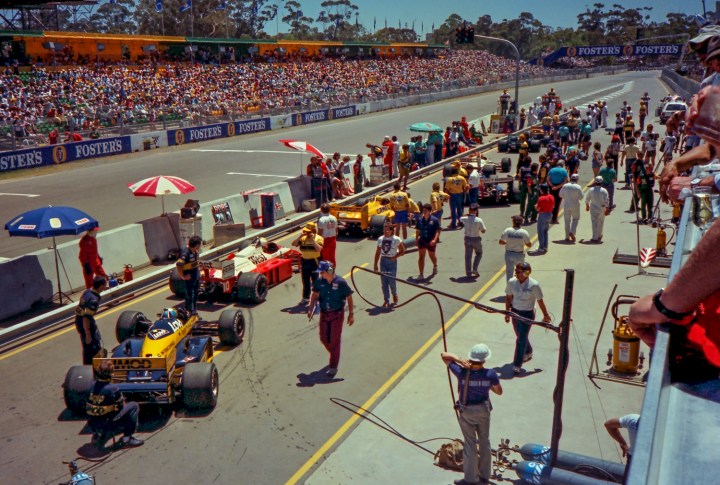
Aus GP10001

1985 proved to be a ‘line in the sand’ for Motorsport Australia organisers, known then as CAMS (Confederation of Australian Motor Sport).

“At that time CAMS wasn’t very highly thought of and a lot of people were concerned or critical that CAMS should be the organisers,” Schenken says.

“A number of people were asking ‘how can this happen? they may be able to run club events but not a Grand Prix!’

“That just showed actually just how good we are and I think from that time onwards Australian motorsport not only drivers, but also officials and organisers have been seen as world class.”

Formula 1’s ventures to US street circuits in Dallas and Detroit the previous year were less than ideal.

Hot mid-summer conditions, coupled with crumbling tracks and the infamous Caesar’s Palace carpark circuit in Las Vegas some years earlier — it’s understandable no one was excited about the addition of another street circuit to the Formula 1 calendar.

Yet the resounding success of the 1985 AGP, the 50th race in AGP history, came from all corners of Formula 1, former F1 commercial supremo Bernie Ecclestone lauded Adelaide’s achievements.

“What Adelaide has done is very bad for Grand Prix racing! They have set a standard some of the established circuits in Europe cannot reach.” — Bernie Ecclestone

Setting the standard

“Not only have we got the best quality marshals in the world but we’ve got the most dedicated army of officials in the world as well, they’re truly outstanding.” — Michael Smith, Motorsport Australia

The standard set by AGP race organisers that year set the bar for all AGP’s that followed, but just what is it about Australian officials and marshals that’s innate to their success?

Director of Motor Sport and Commercial Operations Michael Smith says other Grands Prix around the world have benefited from the assistance and expertise of our race officials and marshals, born out of the AGP success.

australian-grand-prix-young-officials

Marshals at the AGP – Image myroadtrip.net

“I just think it’s probably part of the Australian mentality, we’ve got a really ‘can do’ attitude and that comes through with our motorsport,” Smith says.

“I think we’ve developed a reputation as far back as the Adelaide Grand Prix in the eighties of delivering terrific motorsport events or events generally, that has enabled us to do some training projects with some other Grands Prix around the world.”

“We’ve been involved with the Singapore Grand Prix, Malaysia, Russia, Korea, Abu Dhabi, Bahrain and now the Vietnam Grand Prix.”

What Australians have become renowned for is setting out the framework of safety and engineering around start-up events, especially those run on temporary street circuits like the Adelaide Parkland and Albert Park circuits.

This comprehensive assistance relies solely on an army of volunteer track officials that have helped make the AGP operate year after year.

The AGP enlists the help of just over 950 marshals, despite the eventual cancellation of the 2020 AGP, ironically Smith says the 2020 event is a testament to the dedication of Australian marshals.

“We had all the uncertainty around wether or not the Grand Prix would go ahead on Thursday evening, and as I left the circuit in the very early hours of Friday morning, the one worry I had was wether or not with all the media reporting that was going on, was wether our marshals would turn up,” Smith says

“To turn up at the morning briefing at about eight o’clock the next morning and to see a full contingent of nine hundred and fifty marshals, I think says everything you need to say about the quality and dedication of our marshals, it really was just an outstanding effort and I’m pretty proud to be honest.”

The Volunteers

One of those volunteers at the 2020 AGP, was fire marshal Graham Dickson, Graham was assigned to the McLaren team garage, who were forced to withdraw when a positive COVID-19 case was diagnosed within the team.
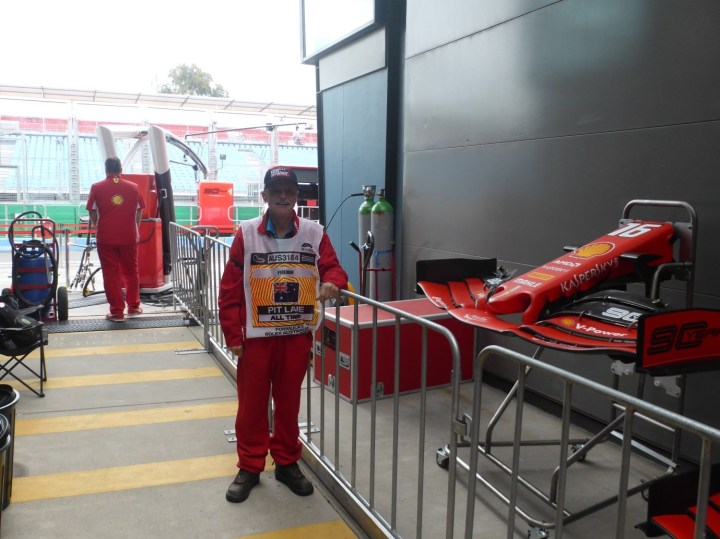
Graham Dickson

Fire marshal Graham Dickson in the Ferrari garage at the 2019 AGP – Image supplied

Graham has been an AGP volunteer for 12 years, bringing to the role over 40 years experience as a volunteer fire fighter, being a motorsport fan is just one of the reasons Graham keeps coming back year after year.

“I have the best seat in the house and because of the camaraderie from making lifelong friendships, you also get placed on a different part of the track each year” Graham Dixon, Fire marshal

Graham’s expertise as a fire marshal plays a hands-on part in the training of other marshals around the world.

“I have officiated at the Singapore Grand Prix for eight years, mentoring and training a young local person there as a fire marshal placed in pit lane with the overseas teams,” Graham says.

It’s these unsung heroes like Graham that put their hand up to play a role in making events safer, despite their proximity to the apparent dangers of motorsport.

Saving the life of a Champion

Over the years of the AGP we as fans remember incidents like Martin Brundle’s crash at Albert Park in 1996, Fernando Alonso’s upside down McLaren in 2016 — the drivers are fortunate to walk away, the marshals make the track safe again and the most delay we have is a safety car, the show goes on.

maxresdefault

Mika Hakkinen talks about his Adealide crash to Sky Sports.

But if we think back to Mika Hakkinen’s crash at Adelaide 1995, when a deflated tyre sent Hakkinen off the track at Brewery Bend, one the circuit’s fastest corners — Fans then witnessed an unabridged instance where all the planning and deployment of track safety and medical personnel came together to save the life of a future World Champion.

Under the then direction of Dr. Sid Watkins, an emergency tracheotomy was performed on track and Hakkinen was rushed to the Royal Adelaide Hospital for life saving treatment.

Recently in his column for Unibet.com, Hakkinen recounted his devastating accident owing his life to the on-track medical teams.

“That caused some serious injuries, putting me in hospital, and I have the medical teams at the circuit and the Royal Adelaide Hospital to thank for saving my life,” Hakkinen says.

Three-time Formula 1 World Champion and motorsport safety advocate Sir Jackie Stewart stressed how vital the on-track response was in Adelaide to Hakkinen’s survival.

hakkinen crash

Medical crews at the Brewery Bend incident. Image: Eurosport

“It must be said that the tremendously fast response to his accident and to the medical crew going out, particularly all the people under Professor Watkins literally saved his (Hakkinen’s) life,” Stewart says.

“Without that action, I fear that we would have been saying different things.”

It’s interesting to note that after Hakkinen’s recovery, his donation to the Royal Adelaide Hospital built a much needed heli-pad on the site.

Taking over the reins

Australian officials role in operating Grands Prix peaked in 2019 when Aussie Michael Masi took over as Formula 1 Race Director and safety delegate in the wake of his predecessor passing, the legendary Charlie Whiting.

Motor Racing - Formula One World Championship - Singapore Grand Prix - Preparation Day - Singapore, Singapore

Michael Masi (AUS) FIA Race Director. at the Singapore Grand Prix – Image: http://www.xpbimages.com

Masi recounts the tragic weekend in an interview with Tom Clarkson, where he was one of the few who knew about Whiting’s passing before it was public.

“It was a tough emotional weekend, particularly knowing what had happened very soon after getting to the circuit but not being able to literally tell a soul,” Masi says.

“But it was something on the other hand I couldn’t be more proud of, the way the entire FIA staff, the F1 community as a whole, with the support of the teams, I was very fortunate that we were in Australia and it was a trackside officiating team that I knew extremely well.”

“Obviously with Tim Schenken as Clerk of the Course, the entire CAMS team and the Australian Grand Prix Corporation whom I’ve had a long relationship, without everyone, that weekend wouldn’t have happened.”

At the time it was the necessary step, but in hindsight it was the natural progression for Masi to take the job, forged by his time in Supercars, F2 and F3 — Masi has just the right pedigree to be the most senior official of the FIA at a Grand Prix says Michael Smith.

I think Michael in the role he does is absolutely a reflection of the environment he’s come from,” Smith says.

“It’s an absolute endorsement of what we do here in Australia and the quality of our people.”

In an F1 season like no other in 2020, Masi has certainly been dealt some challenges trying to put safety first in the face of the COVID-19 pandemic, but we have a season and Masi keeps delivering races that are both safe on track and from a virus.

Featured Image: F1.com

Hamilton survives last lap blowout to win seventh British GP

Standard

Brendan Lines 3rd Aug, 2020

Lewis Hamilton had lady luck on his side taking his seventh British Grand Prix, limping his car home on the final lap on three wheels, ahead of a barnstorming final fastest lap dash from Red Bull’s Max Verstappen in P2.

All eyes were on the midfield battle for 90 per cent of the race as the Mercedes of Hamilton and teammate Valtteri Bottas ran line astern from its front row lockout start positions.

But on lap 50 of 52, it all went wrong as Bottas’ front left tyre suffered a puncture at Turn 3 after showing nervous signs of wear some 10 laps earlier.

Bottas plummetted down the field to finish P11 as he had to complete nearly a full lap on the deflated tyre, his near 30 second lead over Verstappen frittered away as Mercedes were forced to pit Bottas.

With Hamilton looking as though he may just keep his tyres alive with an unasailable gap, Red Bull pitted Verstappen to have a run at the extra championship point on offer for fastest lap.

If only Red Bull had rolled the dice to stay out.

On the final lap Hamilton’s left front also gave way to the brutal loads of Silverstone’s high-speed high-downforce layout.

Hamilton miraculously kept up enough pace and integrity in the tyre after a lockup at the final chicane at Vale to take the grandstand win ironically with no adoring fans to celebrate.

I have never experienced anything like that before. That last lap was one of the most challenging laps I have ever had,” Hamilton said after the race,

“It was a heart-in-your-mouth feeling and then I was just trying to keep the speed up without damaging the car,

“Bono (Hamilton’s engineer) was giving me the gaps; I think it was 30 seconds at one stage, but it was coming down quite quickly and I was thinking ‘How far is it to the end of the lap?’

McLaren were set to take P5 and P6, until Carlos Sainz suffered the same fate as Mercedes on the final lap.

As the field frantically reshuffled on the final lap, Ferrari’s Charles Leclerc was promoted to third, his second podium in 2020.

While Renault’s Daniel Ricciardo seized the opportunity to pass McLaren’s Lando Norris to take a well deserved P4.

The race really came alive and that was really good. We had some pace at the end and I was able to get Lando and then Carlos had a problem. I saw Charles [Leclerc] getting closer and maybe with a couple more laps we could have had a podium! We have another chance next week. We were assisted by some chaos, but we were definitely a top six car today and that’s pleasing,” Ricciardo said.

Ricciardo’s teammate Esteban Ocon took sixth from Racing Point’s Lance Stroll after a race long scrap, it was a low hanging fruit result for Racing Point’s Stroll in P9 while Nico Hülkenberg’s car failed to make the grid on his comeback race.

Pierre Gasly finished in P7 after a strong race that saw him take on battles with Stroll, Ferrari’s Sebastian Vettel (P10), and Alfa’s Antonio Giovinazzi (P14).

Alex Albon salvaged points from an otherwise challenging day in P8, after a five-second time penalty from an incident with Haas’ Kevin Magnussen dropped Albon back to last.

Sebastian Vettel held on to P10 from Bottas coming home on new soft tyres.

Hamilton now extends his 2020 championship lead over Bottas out to 30 points.

Formula 1 returns to Silverstone next week for the 70th anniversary Grand Prix.

Hamilton’s record breaking home GP pole

Standard

Brendan Lines 2nd July, 2020 70:00am

Lewis Hamilton has scored his 91st pole position of his F1 career – his third of 2020 and seventh at the British Grand Prix ahead of teammate Valtteri Bottas, Hamilton’s scintillating pole lap of 1:24.303s is a new Formula One track record at Silverstone.

Hamilton continues to break records with every stride in 2020, but it wasn’t all smooth sailing in quali for the Brit at his home Grand Prix.
“This feeling never gets old, that’s for sure! We made some changes to the car going into Qualifying and it felt worse, so it was a real struggle out there in the first two sessions.” Hamilton said.

“At this track, there can be a headwind, tailwind and crosswind all at different parts of the circuit, so it’s like juggling balls whilst you are on a moving plate,

“Qualifying is a lot about building confidence and after that spin in Q2, I had to take some deep breaths, compose myself and mentally reset – especially knowing Valtteri was putting in fast lap after fast lap,

“Q3 started off well, the first lap was nice and clean, but the second one was even better.

“Hamilton’s off came at Luffield after a rare mistake picking up the throttle swung out his W11’s back end pulling out gravel and the red-flags in Q2.

Bottas was hot favourite to come out and pip Hamilton for the pole having topped the times sheets in Q1 and Q2 — the flying Fin Bottas would have to settle for P2 with a lap of 1:24.616s.

It’s disappointing to be second but the reality is that Lewis found more time in Q3, I just couldn’t quite catch him. He did a really good job today,” Bottas said after quali.

“But tomorrow is what counts and I think my long-run performance has been really good this weekend. I believe there will be opportunities, and everything is still wide open, so I’m looking forward to it.”

Red Bull’s Max Verstappen took P3, but strangely the Dutchman’s time of 1:25.325s is actually slower than his Q3 time in 2019.

The same is for Ferrari’s Charles Leclerc, who made the most out of the low-downforce setup on his SF1000 slotting into P4 with a lap of 1:25.427s, some 0.7s off the Mercs.

Leclerc’s teammate Sebastian Vettel’s miserable weekend continued rounding out the top ten, but starting the race on the more durable Medium tyre could turn the fortunes of the unlucky German.

The McLaren’s were hard to split, drivers Lando Norris and Carlos Sainz at one point posted identical lap times, but in the end Norris became the second Brit in the top ten securing P5 (1:25.782s) and Sainz settled for P7 (1:25.965s).

Lance Stroll didn’t quite capitalise on his FP2 pace, managing to squeeze between the McLaren’s in just P6 (1:25.839s).
An initial run on scrubbed Soft tyres put Esteban Ocon P9 and Daniel in P10.

But the Aussie Ricciardo, found a decent improvement with new tyres on his soft-shod Renault to leapfrog Esteban into P8, with the Frenchman settling for P9 at the chequered flag.

Knocked out of Q2: Gasly P11, Albon P12, Hülkenberg P13, Kyvat P14, Russell P15

It was another disappointing Saturday for Red Bull’s Alex Albon, who despite being just four tenths slower than Verstappen, P12 was all he could manage.

But the big news out of Q2 is George Russell has been served a 5-place grid penalty for Sunday, after failing to slow under yellow flags brought out as a result of teammate Nicholas Latifi spinning out.

A gearbox change for Daniil Kyvat will mean his Alpha Tauri will drop to P19 after serving his penalty from Friday.

Knocked out Q1: Magnussen P16, Giovinazzi P17, Räikkönen P18, Grosjean P19, Latifi P20

No surprise the under performing Ferrari power units in the Alfa and Haas cars has again been the bogey for both teams who make up the back rows ahead of Williams’ Nicholas Latifi.

The British Grand Prix starts 10.40PM ACST tonight.

Stroll fastest as Albon’s crash red-flags FP2

Standard

Brendan Lines 1st August, 2020 10.00am

Racing Point continue to make headlines at the British Grand Prix as Lance Stroll went fastest in Friday’s FP2 ahead of Red Bull’s Alex Albon in P2 before the session was red-flagged when Albon’s RB16 smashed into the barriers at Stowe.

Stroll’s fastest lap of 1:27.274 was +0.090 faster than Albon, just over two-tenths quicker than Max Verstappen’s fastest time in FP1.

It’s been a positive day and it feels great to be on top in FP2. The car was strong on both the short and long runs today, so it’s a promising start to the weekend for us. We knew coming into the weekend that Silverstone could suit the car and it looks like we’ve got a good shot at some big points this weekend, although qualifying and the race are where it really matters.” Stroll said after FP2.

Stroll’s new stand-in teammate Nico Hülkenberg continued his impressive fast-tracked return to F1 finishing P7.

Albon’s crash at Stowe saw the Thai driver hit the barriers backwards after correcting his sliding RB16, the subsequent impact triggered the car’s G-force sensor, Albon was clearly shaken but was later cleared by track medics.

The hot conditions scorched Silverstone as track temperatures peaked at 50°C as teams began their qualifying simulations.

Mercedes’ Valtteri ended the second session in P3 (1:27.431s), with teammate Lewis Hamilton in P5 (1:27.481s), the team’s focus was on single-lap performance on the Soft tyre, alongside long-run balance and the warm-up slope of the harder compounds.

Ferrari’s Charles Leclerc survived a spin at The Loop to post a lap of 1:27.520s for P4, while teammate Sebastian Vettel overcame his intercooler issues from FP1, but a loose component in the cockpit slowed his run, the German finished in P18 one and a half seconds off the pace.

McLaren’s Carlos Sainz put in the most laps run for the session (35) on the Medium and Soft tyres to finish P6 (1:27.820s), while fellow McLaren driver Lando Norris was back in P11 eight tenths off Stroll’s pace.

Alpha Tauri made a step forward from FP1, but in FP2 the red flags and the traffic did not allow drivers Pierre Gasly and Daniil Kyvat to get the best out of the option tyres on the short run, Gasly finished in P8 (1:27.997s) and Kyvat P15 (1:28.426s).

Both Renault drivers predominantly ran on Hard tyres in preparation for Sunday’s race with a quick outing on Softs for pre-qualifying assessments, Australia’s Daniel Ricciardo finished P9 (1:28.112s) with teammate Esteban Ocon in P12 (1:28.219s).

Alfa Romeo’s Kimi Räikkönen rounded out the top 10 with a lap of 1:28.159s, and Antonio Giovinazzi ran in P13.

The hot conditions are expected to change overnight in Newhamptonshire with 10°C cooler temperatures and rain forecast for Saturday’s qualifying.

FP3 and Qualifying sessions begin from 7.30pm ACST tonight.