Brendan Lines April 9, 2020
For now the spectacle of live-sport has fallen silent on the air-waves, as the bottom-line of the AFL’s gargantuan commercial interests with its broadcasters, sponsors, clubs and star-players gets decimated by the COVID-19 pandemic. There is however an obvious but less recognised spate of collateral damage affecting the TV crews who bring us the endless ‘on-tap’ AFL coverage we take for granted.
Every weekend just over 400 crew members, like Adelaide’s Laci Katsaparas, work behind the scenes of the AFL’s TV coverage across the country. It’s the ‘bread and butter’ for many of the crew members like Laci, who has worked as a Camera Control Unit-operator (CCU) for over twenty-five years broadcasting AFL.
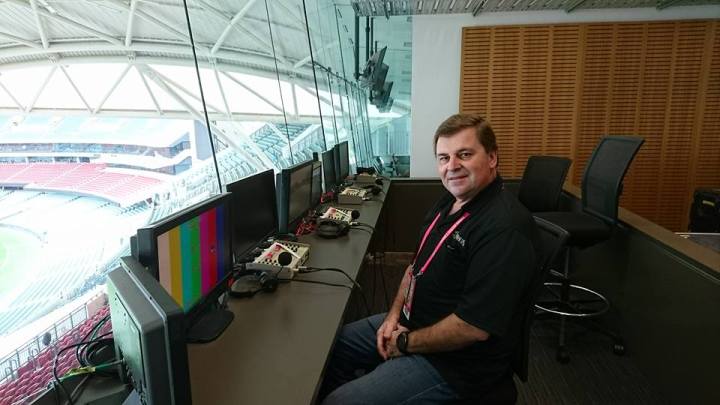
Adelaide TV crew member Laci Katsaparas in the Adelaide Oval commentary Box – Image: In Phase Vision.
For us watching at home, we sometimes get a glimpse of the camera-operators braving the elements on the front-line, but it’s in unseen roles like Laci’s, that teams of professional technical boffins put the show to air.
“I’ve always been a behind the scenes person, I like being part of the team where you’re not at the front where people see, the public see the camera man and that’s it, they don’t realise there’s another thirty or fifty people in a truck somewhere, buried in some loading-dock at the Adelaide Oval,” Laci says.
‘Unmanned’ front-line Camera and Director’s positions at the Adelaide Oval – Image: In Phase Vision.
The TV industry is made up of a highly casualised and freelance workforce, so when the AFL was forced to suspended its 2020 season in response to the pandemic in March, Laci and all his fellow crew members’ livelihoods were hit with immediate effect.
“Yes, I can say that many people not just in my role in CCU, but of course the cameramen, you’ve got audio, you’ve got the replay guys and girls in the truck, the technicians, the whole team right through the chain has been affected exactly the same — no work basically, that’s it,” Laci says.
“Because there are no sporting events and no one can travel around from state to state, it’s actually hit us right in the head from minute number one, bang, there’s no television coverage.
“Unfortunately, I’m in the situation where I don’t work at say a television station on the news floor where they’re still going, but in our situation in the outside broadcasting sporting world, until they bring televised sport programming back, we’ve got nothing to televise, unfortunately it’s hit us very hard indeed,” Laci says.
Many of the AFL’s support services like Film, Television, Entertainment and Events workers, typically operate in a ‘gig-economy,’ where colloquially “you are only as good as you’re last gig” is a phrase to live by.
Further uncertainty surrounds the many TV workers on temporary visas, who would have worked on international sports coverage.
The fluidity of the pandemic saw TV crews released from their jobs just days following the AFL’s suspension.
At a first glance the TV industry operates like many other businesses, look deeper and you’ll find highly specialised-skilled people working with multi-million dollars worth of bespoke equipment, across a raft of live-sports all with their own tailored requirements.
Over the years Adelaide’s TV crews have bared witness and brought to our screens many memorable sporting moments such as; the Tour Down Under, Adelaide United’s 2016 A-League Grand Final win, the Adelaide 500 and Adelaide Grand Prix motorsport events.
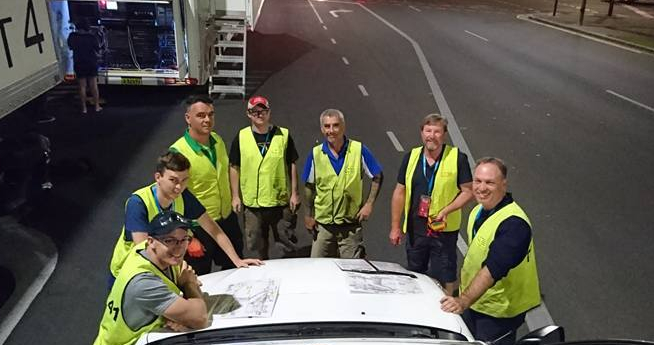
Adelaide TV team preparing for the Tour Down Under – Image: In Phase Vision.
But despite their skills, it’s not so simple for Laci and many of his colleagues to find other work straight away.
“The actual role as a CCU operator is a hands on role, it’s a right there and then job at hand, you can’t take it away unless you’ve got the same equipment elsewhere, the job won’t go anywhere else,” Laci says.
“The skills we learn along the way, how to install cables for public venues, to make it all health and safety compliant, those are skills I could take anywhere but of course I’ve got to find the right job to apply those skills, a bit of a yes and no question, I can, but I can’t find other work for now.”
When talking to Laci, you learn very quickly that he is very passionate and feels privileged to work in a job he finds highly satisfying, having worked at every Showdown — ever, Laci’s also worked with Channel 9’s classic Cricket commentary team led by legendary broadcaster Richie Benaud, along with other revered sporting personalities.
“I worked on a Soccer O.B at West Lakes in Adelaide, Pelé came down we had to interview him, so I actually got to talk to him off-camera at the end of the interview and he gave me a hug, it was really great,” Laci says.
The highs and lows ‘behind the scenes’ play-out much like the highlight packages we all cheer and rue over. For better or worse, working at an empty Adelaide Oval for the Adelaide Crows’ round-one clash with Sydney is one of those moments.

An empty Adelaide Oval just before the Crows and Sydney round-one clash – Image: In Phase Vision.
“It was very surreal, we were walking around in the morning with no one getting allowed in,” Laci says.
“We had it in the back of our mind it could have been the last one, we prepared for it, but we also left equipment in thinking we’d be back the very next week.”
The state of flux around the unemployed casuals and freelancers from the pandemic is only exacerbated by postponements to the Olympic Games until 2021, signalling impacts to livelihoods are going to be long-term.
Broadcast companies have now gone ‘into bat’ for their crews to secure the Federal Government’s $130bn JobKeeper support package — which might be just the life-line workers like Laci need to make ends meet during the pandemic.
“We’re getting emails how to cope with the Coronavirus and how the company is dealing with the situation that is arising from the virus, including all the new government regulations and government subsidies that are rolled-out and introduced,” Laci says.
“So we are getting kept in the loop of what we can expect and what we are expected to do, they’ve been extremely supportive it has been great.”
Put simply the only time any certainty will return to the lives of Laci and broadcast crews everywhere won’t be until live-sport is back on the air.








 Racing Point team-owner Lawrence Stroll – Image: BWT Racing Point F1 Team
 Grandprixnet.com