Safety First: Australia’s role in 70 years of F1

Standard

Brendan Lines August 6, 2020

A Grand Prix is one of world sport’s greatest live spectacles showcasing high-octane speed and fanfare, but once upon a time competing in a Grand Prix was equally as dangerous as being there. Across Formula 1’s 70 years, Australian officials and marshals have come to be world leaders in training and safe operation of Grands Prix the world over.

In a second part to our series ‘As Aussies As They Come: 70 Years of Australians in F1’ Local Goals takes a look at our unsung heroes standing track-side.

The dangers of competing in Formula 1 is a confronting thought drivers and fans have sometimes naively put to the back of their minds says former F1 driver (from 1970 to 1974) and now Motorsport Australia Director Tim Schenken.

“It’s strange because racing in those days, we used to think ‘thank goodness we’re racing today and not in the fifties,” Schenken says.

Schenken recalls the time he lost close friend Ronnie Petersen, as a result of his injuries from a first-lap incident at the 1978 Italian Grand Prix.

“Even today it’s a bit of a lump in my throat, it’s sad so many lives were lost, but that’s the nature of the sport at the time and of course today that wouldn’t be accepted to have those sorts of accidents.” — Tim Schenken

Today, those accidents would not be accepted, as planning and implementing measures that mitigate and prevent their occurrence has not only lead to safer races but overall better Formula 1 events.

1985: A line in the sand

The Australian Grand Prix (AGP) remains the ‘gold standard’ as one of the best organised Grands Prix in Formula 1.

When the inaugural world championship race was green-lit to go ahead in Adelaide in 1985, many people outside of the city never took race organisers seriously.
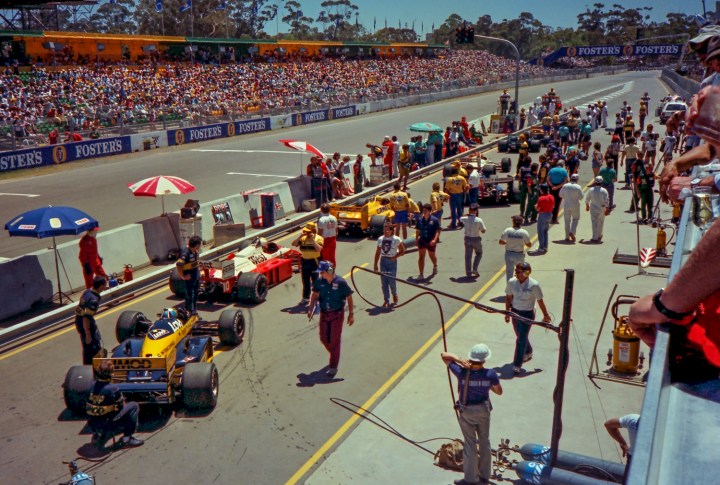
Aus GP10001

1985 proved to be a ‘line in the sand’ for Motorsport Australia organisers, known then as CAMS (Confederation of Australian Motor Sport).

“At that time CAMS wasn’t very highly thought of and a lot of people were concerned or critical that CAMS should be the organisers,” Schenken says.

“A number of people were asking ‘how can this happen? they may be able to run club events but not a Grand Prix!’

“That just showed actually just how good we are and I think from that time onwards Australian motorsport not only drivers, but also officials and organisers have been seen as world class.”

Formula 1’s ventures to US street circuits in Dallas and Detroit the previous year were less than ideal.

Hot mid-summer conditions, coupled with crumbling tracks and the infamous Caesar’s Palace carpark circuit in Las Vegas some years earlier — it’s understandable no one was excited about the addition of another street circuit to the Formula 1 calendar.

Yet the resounding success of the 1985 AGP, the 50th race in AGP history, came from all corners of Formula 1, former F1 commercial supremo Bernie Ecclestone lauded Adelaide’s achievements.

“What Adelaide has done is very bad for Grand Prix racing! They have set a standard some of the established circuits in Europe cannot reach.” — Bernie Ecclestone

Setting the standard

“Not only have we got the best quality marshals in the world but we’ve got the most dedicated army of officials in the world as well, they’re truly outstanding.” — Michael Smith, Motorsport Australia

The standard set by AGP race organisers that year set the bar for all AGP’s that followed, but just what is it about Australian officials and marshals that’s innate to their success?

Director of Motor Sport and Commercial Operations Michael Smith says other Grands Prix around the world have benefited from the assistance and expertise of our race officials and marshals, born out of the AGP success.

australian-grand-prix-young-officials

Marshals at the AGP – Image myroadtrip.net

“I just think it’s probably part of the Australian mentality, we’ve got a really ‘can do’ attitude and that comes through with our motorsport,” Smith says.

“I think we’ve developed a reputation as far back as the Adelaide Grand Prix in the eighties of delivering terrific motorsport events or events generally, that has enabled us to do some training projects with some other Grands Prix around the world.”

“We’ve been involved with the Singapore Grand Prix, Malaysia, Russia, Korea, Abu Dhabi, Bahrain and now the Vietnam Grand Prix.”

What Australians have become renowned for is setting out the framework of safety and engineering around start-up events, especially those run on temporary street circuits like the Adelaide Parkland and Albert Park circuits.

This comprehensive assistance relies solely on an army of volunteer track officials that have helped make the AGP operate year after year.

The AGP enlists the help of just over 950 marshals, despite the eventual cancellation of the 2020 AGP, ironically Smith says the 2020 event is a testament to the dedication of Australian marshals.

“We had all the uncertainty around wether or not the Grand Prix would go ahead on Thursday evening, and as I left the circuit in the very early hours of Friday morning, the one worry I had was wether or not with all the media reporting that was going on, was wether our marshals would turn up,” Smith says

“To turn up at the morning briefing at about eight o’clock the next morning and to see a full contingent of nine hundred and fifty marshals, I think says everything you need to say about the quality and dedication of our marshals, it really was just an outstanding effort and I’m pretty proud to be honest.”

The Volunteers

One of those volunteers at the 2020 AGP, was fire marshal Graham Dickson, Graham was assigned to the McLaren team garage, who were forced to withdraw when a positive COVID-19 case was diagnosed within the team.
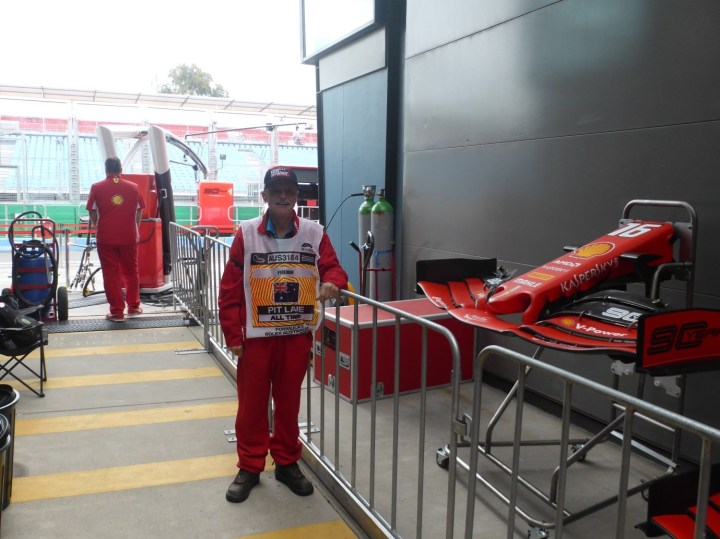
Graham Dickson

Fire marshal Graham Dickson in the Ferrari garage at the 2019 AGP – Image supplied

Graham has been an AGP volunteer for 12 years, bringing to the role over 40 years experience as a volunteer fire fighter, being a motorsport fan is just one of the reasons Graham keeps coming back year after year.

“I have the best seat in the house and because of the camaraderie from making lifelong friendships, you also get placed on a different part of the track each year” Graham Dixon, Fire marshal

Graham’s expertise as a fire marshal plays a hands-on part in the training of other marshals around the world.

“I have officiated at the Singapore Grand Prix for eight years, mentoring and training a young local person there as a fire marshal placed in pit lane with the overseas teams,” Graham says.

It’s these unsung heroes like Graham that put their hand up to play a role in making events safer, despite their proximity to the apparent dangers of motorsport.

Saving the life of a Champion

Over the years of the AGP we as fans remember incidents like Martin Brundle’s crash at Albert Park in 1996, Fernando Alonso’s upside down McLaren in 2016 — the drivers are fortunate to walk away, the marshals make the track safe again and the most delay we have is a safety car, the show goes on.

maxresdefault

Mika Hakkinen talks about his Adealide crash to Sky Sports.

But if we think back to Mika Hakkinen’s crash at Adelaide 1995, when a deflated tyre sent Hakkinen off the track at Brewery Bend, one the circuit’s fastest corners — Fans then witnessed an unabridged instance where all the planning and deployment of track safety and medical personnel came together to save the life of a future World Champion.

Under the then direction of Dr. Sid Watkins, an emergency tracheotomy was performed on track and Hakkinen was rushed to the Royal Adelaide Hospital for life saving treatment.

Recently in his column for Unibet.com, Hakkinen recounted his devastating accident owing his life to the on-track medical teams.

“That caused some serious injuries, putting me in hospital, and I have the medical teams at the circuit and the Royal Adelaide Hospital to thank for saving my life,” Hakkinen says.

Three-time Formula 1 World Champion and motorsport safety advocate Sir Jackie Stewart stressed how vital the on-track response was in Adelaide to Hakkinen’s survival.

hakkinen crash

Medical crews at the Brewery Bend incident. Image: Eurosport

“It must be said that the tremendously fast response to his accident and to the medical crew going out, particularly all the people under Professor Watkins literally saved his (Hakkinen’s) life,” Stewart says.

“Without that action, I fear that we would have been saying different things.”

It’s interesting to note that after Hakkinen’s recovery, his donation to the Royal Adelaide Hospital built a much needed heli-pad on the site.

Taking over the reins

Australian officials role in operating Grands Prix peaked in 2019 when Aussie Michael Masi took over as Formula 1 Race Director and safety delegate in the wake of his predecessor passing, the legendary Charlie Whiting.

Motor Racing - Formula One World Championship - Singapore Grand Prix - Preparation Day - Singapore, Singapore

Michael Masi (AUS) FIA Race Director. at the Singapore Grand Prix – Image: http://www.xpbimages.com

Masi recounts the tragic weekend in an interview with Tom Clarkson, where he was one of the few who knew about Whiting’s passing before it was public.

“It was a tough emotional weekend, particularly knowing what had happened very soon after getting to the circuit but not being able to literally tell a soul,” Masi says.

“But it was something on the other hand I couldn’t be more proud of, the way the entire FIA staff, the F1 community as a whole, with the support of the teams, I was very fortunate that we were in Australia and it was a trackside officiating team that I knew extremely well.”

“Obviously with Tim Schenken as Clerk of the Course, the entire CAMS team and the Australian Grand Prix Corporation whom I’ve had a long relationship, without everyone, that weekend wouldn’t have happened.”

At the time it was the necessary step, but in hindsight it was the natural progression for Masi to take the job, forged by his time in Supercars, F2 and F3 — Masi has just the right pedigree to be the most senior official of the FIA at a Grand Prix says Michael Smith.

I think Michael in the role he does is absolutely a reflection of the environment he’s come from,” Smith says.

“It’s an absolute endorsement of what we do here in Australia and the quality of our people.”

In an F1 season like no other in 2020, Masi has certainly been dealt some challenges trying to put safety first in the face of the COVID-19 pandemic, but we have a season and Masi keeps delivering races that are both safe on track and from a virus.

Featured Image: F1.com
Haas first to launch in 2020 with ‘throwback’ livery

Standard

Brendan Lines

February 7, 2020

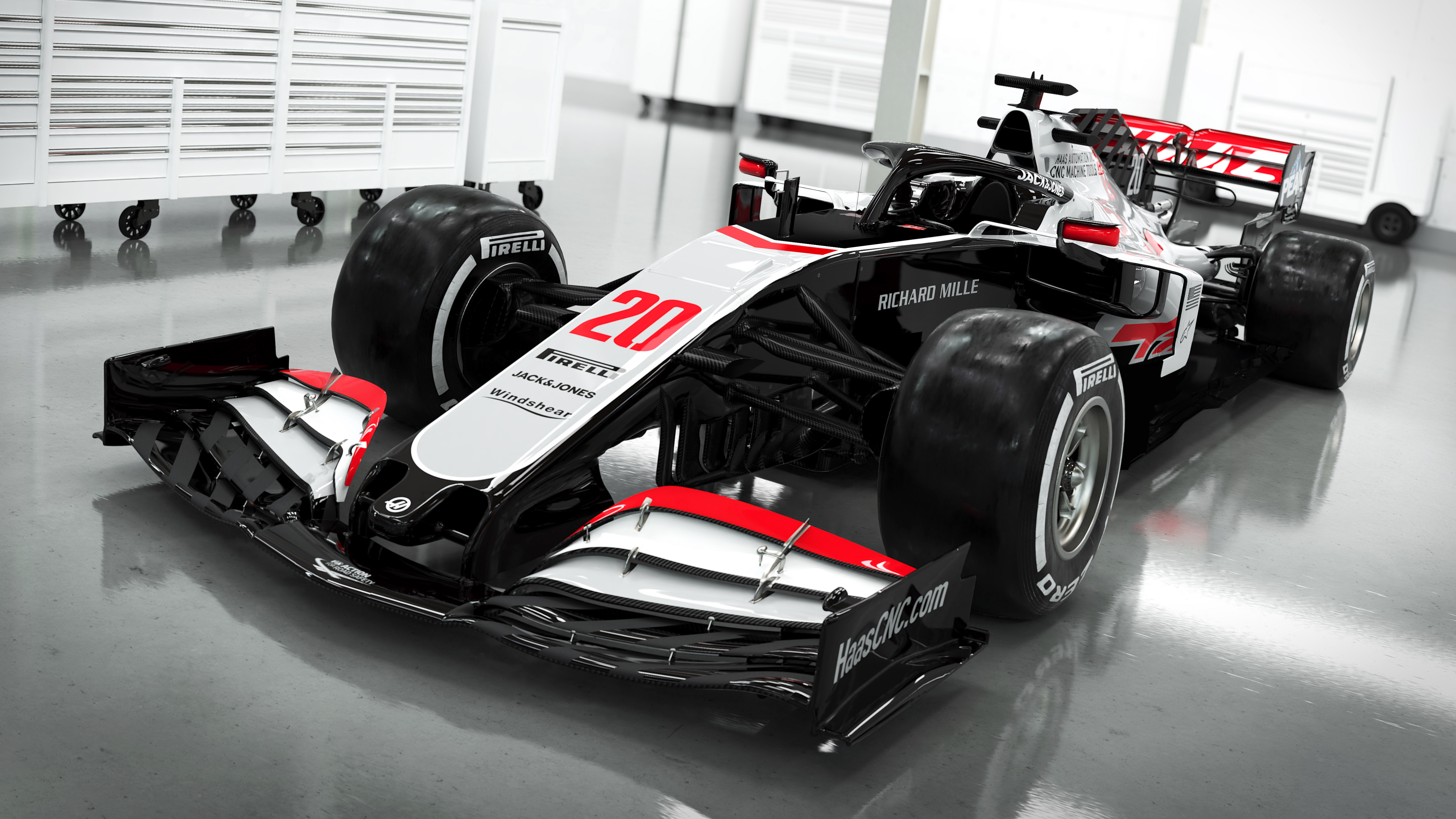
US based Haas F1 Team are the first to unveil its livery for the 2020 season launching the VF-20 in traditional colours that is hoped to correct the mistakes of the past. But all has not been fully revealed as the physical version of VF-20 is yet to take shape before it turns a wheel at Albert Park in March.

VF-20 livery – Image: Haas F1 Team

The VF-20 will sport a familiar look this year, harking back to the colours of founder Gene Haas’ Haas Automation. Fans will instantly recognise the black, red and white livery that has been a constant theme since the teams F1 debut in 2016.

Despite the teams forgettable performance in 2019, coupled with the defunct title sponsor deal with Rich Energy — which saw Haas adopt the energy drink company’s black and gold livery for the VF-19.

Last year’s Australian Grand Prix yielded a rare points finish for the VF-19 as Driver Kevin Magnussen took 6th at Albert Park in 2019.

The familiar yet fresh look of the VF-20 is hoped by Gene Haas to be a return to form.

“Frankly, I’m hoping the VF-20 will return us to the kind of form we ran in 2018 when we finished fifth in the constructors’ championship. 2019 was a tough season to endure.” – Gene Haas

VF-20 livery – Image: Haas F1 Team

Haas will wait until the opening day of pre-season testing on February 19 at Circuit de Barcelona-Catalunya, Spain — for the VF-20 to make its physical debut.

Team Principle Guenther Steiner said on Twitter today:

“We are back to the old days, which are not this old.”

A great deal of expectation in the VF-20s performance is pinned on capitalising from stable regulations in place this season.

Steiner hopes stability will allow the VF-20 to deliver where the VF-19 did not.

“It’s allowed us to improve our understanding of the car and to scrutinize ourselves more in order to find solutions and applications to channel into the design of the VF-20. Last year was definitely a set-back, one I would never have asked for, but you learn from such situations – we all have. Everybody at the team was forced to look at themselves and understand what they can do better. I’m looking forward to seeing the VF-20 make its track debut. As always in testing, you want many things, but lots of mileage, reliability and speed would be welcomed as we ready ourselves for the first race in Australia,” he said.

As Haas fans wait with bated breath for the pre-season reveal, there is still much to play out that will affect just what car will line up on the grid at Albert Park.

If we can learn anything from Haas’ links to engine partner Ferrari, there is likely to be some similar ideas.

McLaren’s long road back to the F1 podium

Standard

Above Image: Getty Images

Brendan Lines

November 22, 2019

At last Sunday’s Brazilian Grand Prix McLaren secured its first podium finish in 2,072 days locking away fourth place in this year’s constructors championship, after a post-race time penalty handed to Mercedes’ Lewis Hamilton promoted Carlos Sainz on to the podium, so just how has McLaren risen from the ashes of its past woes?

It hasn’t been a straight road by any means for McLaren after the failed rekindling of the Honda partnership, departure of Adrian Newey, loss of Lewis Hamilton and the infamous ‘Spygate’ saga that caused instability on and off the track — McLaren have finally turned the tide toward a brighter future.

Team Principle Andreas Seidl said to McLaren.com it was a team effort pulling off the great result in Brazil.

“P4 in the Constructors’ World Championship for McLaren secured. First podium for Carlos in his F1 career and first podium for McLaren since 2014. What an amazing achievement for the entire team back home in the factory plus here at the track, and for Carlos and Lando after putting in so much hard work throughout the year.”

Winning on their own terms is very much accustomed to the Woking based team, who over their 56-year history have seen dominant eras gilded by silverware from 12 Drivers’ and eight Constructors’ World Championships.

There has almost been an expectation that McLaren would always be a winning team. Yet not to have won a race in seven years, that being Jenson Button at Interlagos in 2012 — is unprecedented. McLaren’s last taste of ultimate success came when Lewis Hamilton won his first Driver’s World Championship in 2008.

But the cracks were just appearing at McLaren in 2007 during the fallout of the ‘Spygate’ espionage controversy. Off the track, ‘Spygate’ signalled there was instability in McLaren’s ranks.

It was a tumultuous time that exposed alleged theft of Ferrari technical data and a rift between then Team Principle Ron Dennis and Fernando Alonso, as Alonso accused the team of favouring Dennis’ young protege Hamilton.

Dennis retired as team principle in 2009 and eventually parted completely in 2017 after his 37 year association with the McLaren Technology Group. During his time Dennis oversaw McLaren’s most successful period across the 1980s and 1990s.

In 2015 McLaren went back to Honda engines for the first time since 1992, in what began as a hark back to the halcyon days of the Honda powered MP4/4 winning 15 out of 16 races and Ayrton Senna’s first world championship in 1988.

But the ‘McLaren-Honda 2.0’ partnership ended in an unmitigated disaster as the team slumped to ninth in the constructors’ championship in 2017.

Yet like any good comeback story there has to be a pivotal point where the fight back to the top begins.

That began when motorsport marketing guru Zac Brown took over as McLaren CEO, Brown said to McLaren.com he took over at the most difficult time.

“I definitely joined in probably the most difficult period in the team’s history, but to me that’s the exciting part. That’s the challenge. What we needed to do was provide clear leadership and direction, and ensure the right people were in the right places. I think we’re now going in the right direction. The decisions we have made are paying off, but there’s still a long way to go.”

The first milestone on the road back success came when Brown divorced McLaren from its partnership with Honda in 2016, striking a new engine supply with Renault.

Brown also oversaw the increase of sponsorship investment and was instrumental bringing Seidl to the team along with James Key as Technical Director.

Brown also attributes the teams renewed stability from retaining the services of drivers Sainz and Lando Norris.

“We’re currently in a period of rebuilding and we want stability. Both Carlos and Lando are performing well and we’re very happy with them, therefore we wanted to confirm them early. I’m sure there are many teams that would love to have either of them in a race car and by confirming them when we did, we avoided getting caught up in ‘silly season,” he said.

It was quite fitting that Sainz’s P20 to P3 drive at Interlagos very much echoed McLaren’s fight back to the podium, but despite the much welcomed success, Seidl said to McLaren.com he is now looking for success on the teams’ own terms.

“We keep our heads down and now focus on securing our positions in the Drivers’ World Championship. The achievement this year together with the podium today is the perfect motivation for all of us to keep working hard in order to score podiums again in the future for McLaren based on our own outright performance.”

With great results in the bag for 2019 and a revitalised partnership with Mercedes as their new engine supplier in 2021, the team as a collective appears now to have their heads in a good space for the challenges ahead, to finally get that elusive win they so desperately hunger.

A curious look: How Lewis Hamilton is creating a Formula 1 masterpiece

Standard

Brendan Lines

As Lewis Hamilton adds his sixth Formula 1 World Championship to his impressive career, amongst the celebrations, his unbound success and Michael Shumacher — just how is Hamilton’s journey this season helping him create a Formula 1 masterpiece?

preview-1.jpg

Image: Associated Press

As the champagne flowed at the US Grand Prix on Sunday, the immediate reaction for most was ‘who would have thought?’ anyone would come this close to Michael Shumacher’s seven world titles.

But with all the comparisons and a plethora of statistics drawn between Hamilton and Schumacher aside, are we witnessing a champion more happier in his own skin to face his challenges along the way than simply to beat Shumacher’s record.

Buried in the magic of the moment we heard post-race at the US Grand Prix a side of Lewis Hamilton that reflected upon a more human element to his world championship success, in terms of; the effect from the loss of Nikki Lauda, to battling his demons and his journey towards a masterpiece.

At Sunday’s press conference Hamilton said to www.formula1.com that the loss of Lauda was a great loss to him personally and the team.

“No way has it been the easiest. It’s been the hardest year for us as a team. We lost Niki this year. A crucial member and a real pivotal member of our team and the emotional rollercoaster that we’ve been on with losing him,

“I would say this year that losing Niki, I didn’t think that was going to hit me as hard as it did. It really was upsetting and I miss him dearly today and I didn’t realise how much I loved the guy.”

Yet beneath Hamilton’s cheerful demeanour and all the success, the loss of Lauda and sometimes languishing speed of the Mercedes this year, forced Hamilton to face up to what he says is to be ‘battling certain demons.’

“There’s always the darker side that’s always trying to pull you down and you’re constantly having to wake up… I don’t know how you guys wake up in the morning but I look in the mirror and I’m trying to lift myself up and say ‘yes, you can do it. Yes, you are great. Yes you can be fit if you go and put that time in. Yes, you can win this race if you do the right steps and you continue to believe in yourself, and no one else is going to do it for you,” he said.

Hamilton has become a person who wears his ‘heart on his sleeve,’ speaking more candidly about what it takes to remain successful, wether that’s just maturity alone is debatable.

Clearly Hamilton’s motivations since 2007, as a rookie who was simply hungry for that first win have changed. As Hamilton now draws a more philosophical approach to how he sees his F1 journey unfolding.

At Sunday’s press conference Hamilton said to www.formula1.com he is creating a masterpiece.

“I’m working on a masterpiece and I haven’t quite finished it yet, so I’m trying to understand, I think it takes a long time to master a craft, while I feel like I am mastering it there’s still more to master, there’s still more to add to it, theres still more pieces of the puzzle to add, there’s going to be more ups and downs along the way but I feel like I’ve got the best tools now, at this point at least to deal with those.” 

There is no doubt the biggest part of that masterpiece is his relationship with Mercedes. Where out of Hamilton’s six world titles five of them have been won during Formula 1’s turbo-hybrid era from 2014 under team boss Toto Wolff.

On Sunday Wolff said to the Daily Mail  there maybe no lid on Hamilton’s success.

“I think there is no limit to what he can win. He is still very motivated and you can see he wants to win every single race. As long as that is the case, he can go for more.” 

Later, Wolff said to www.formula1.com there is however a role the team must play.

“If we’re able to provide the drivers with a good car next year, that is competitive, we continue to work on the gaps we still have, try and minimise the mistakes and he has a good season, there is no reason why he couldn’t go for a seventh title,” he said.

If we now pause after all this and ask how does this dominance continue?

We immediately think Hamilton just needs to have the fastest car to capitalise on the current stable regulations, that maybe true — but there is one condition.

As the new ‘game-changing’ regulations for the 2021 season were locked in over the weekend, does it potentially limit Hamilton’s window to 2020 in order to match Shumacher?

The answer to that is anyones guess, but if we look at success the way Hamilton now sees it  — is there really an end date on a masterpiece? Which leaves the possibility to suggest Hamilton’s trajectory of success could well continue despite Formula 1’s shifting regulations, writing a truly unique piece of Formula 1 history next to the greats.

 This website is unofficial and is not associated in any way with the Formula 1 companies. F1, FORMULA ONE, FORMULA 1, FIA FORMULA ONE WORLD CHAMPIONSHIP, GRAND PRIX and related marks are trade marks of Formula One Licensing B.V.